What’s in a blurb?

I’ve seen people discussing story blurbs in their query letters, and there seems to be confusion over whether the blurb is meant to be what you see on the back of the book when it’s published, or if it’s meant to be more of a quick summary for potential agents.

As far as I understand it, the query blurb is meant to be “the hook” that captures the agents’ attention and lets them know a brief bit about the story so they can quickly get an idea of what they can expect as far as the novel’s marketability.

The blurb on the back of published books is similar, but it can be longer and more flowery with its wording. It’s meant to entice readers to buy the book. Both are marketing-related, but the former is purely for business whereas the latter is meant to be more creative.

Remember, not everyone buys books. Libraries and borrowing from friends are legitimate ways to read a book. Readers tell their friends, and their friends check out the back of the book or the summary online to see if they would also like to read it.

Agents and publishing houses, on the other hand, want to be able to tell how well a book would do with readers so they can sell a lot of copies. They want to see, in roughly two paragraphs, who the characters are and what’s at stake. Does it align with their current markets? Are there too many books about the subject at the moment? They care about those sorts of things. The big picture of publishing.

Then, of course, there’s the synopsis! That’s essentially a two-page outline of everything that happens in the book. It’s meant to spoil the ending, so it’s not something you’d be sharing with anyone who wants to read the novel as a reader.

This has been Sara Understands Publishing. Tune in next week for maybe more writing tips, but maybe something else entirely.

Britlit.

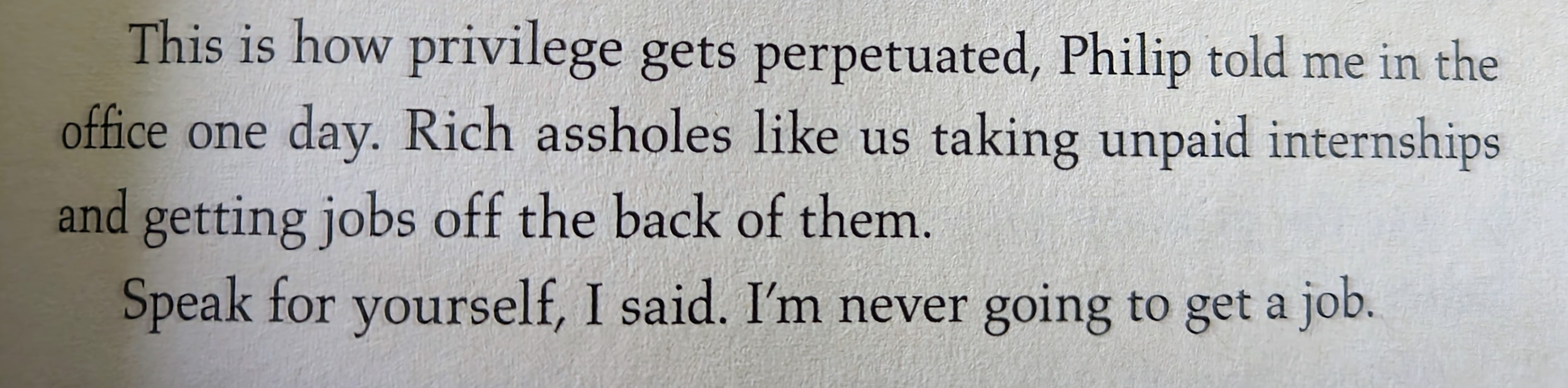
I recently started reading Conversations with Friends by Sally Rooney. Immediately, I was captivated, but one thing sticks out to me as I read: the lack of quotation marks for the dialogue.

There are many U.K. idiosyncrasies in writing. Favourite, colour, kerb (?!) Whenever I discover one, I’m usually delighted. After all, I wrote “dialogue” in the paragraph above. I’ve been spelling it “theatre” my entire life. There are some British spellings that just make sense to me.

But I just can’t get behind not using quotation marks. Thoughts and spoken words are written out the same way, and the narration is also in first person, so I have to read sections a second time just to keep track of what was said.

Example:


Now, admittedly, I’m a dumb American. But since when are quotation marks not hip enough to be used in a novel? I’m genuinely curious. This reads more clearly to me:

“This is how privilege gets perpetuated,” Philip told me in the office one day. “Rich assholes like us taking unpaid internships and getting jobs off the back of them.”
“Speak for yourself,” I said. “I’m never going to get a job.”

‘kerb’ is just a silly British quirk to me, but the quotation thing is perplexing.

The waiting game.

In my experience thus far, there are three main steps to post-writing a novel manuscript:

  1. Elation at having finished! Everyone should know and maybe a bunch of friends should read it?! Such proud.
  2. Wait, wait, wait. This needs to be edited. Reread and edited more. Maybe it’s not as amazing as once believed… But you can make it so!
  3. Query anxiety. <– this is where I am. The manuscript is finished, but now you have to advertise it to potential representation. Crying at this stage is perfectly natural.

I joined a writing forum that seems quite helpful. I signed up for a writing advice newsletter. I shared my novel with some earnest beta readers. It seems like I’m doing everything the correct way.

My buddy Patience and I are just gonna have to get better acquainted.

It’s a process.


Tra la, la, la, la. Spring is in the air. And I’m a flower with nothing interesting to say. 

I think of this line from A Bug’s Life every spring.

Now that I’ve finished reading through my novel and giving it more little edits, I’ve sent it off to some more beta readers for their feedback. I went with some Nerdfighter volunteers, which makes sense to me because themes in my novel are based on the Nerdfighter community. It’s a novel about becoming an independent adult, finding your own path in an era where that seems almost impossible, and finding love and companionship along the way.

I learned from Ellen Brock that I’m an intuitive planner – that’s at least the closest writer “type” I align with. I have a book outline, but I’ve also been going with my gut feelings regarding the plot and flow of the story. I feel like I’m the same with everything in my life: I have a general idea/plan, but then I kind of go with how I feel in order to get there.

If that makes sense.

Nobody told me how much patience goes into writing a novel. That’s been the hardest part, for me. I keep having to remind myself that it’s a process. Steps have to be taken, and some of them take longer than others. Some of them aren’t as fun. But it’s all a part of it.

#Goals.

When you were five, what did you want to be when you grew up?

A cat. I remember my kindergarten had a “circus day” and I was dressed like a little tiger. I was always crawling around, pretending to be animals. I didn’t actually have career aspirations; I simply wished to change species. When I was a little older, I read Animorphs and envied Rachel for getting to be a cat.

In middle school, I had dreams of being in Cats. I religiously watched my VHS copy of the PBS-televised Andrew Lloyd Webber musical, copying the dance moves in my parents’ living room. I was taking ballet, tap, and jazz dance at the time. I thought I was Broadway-bound for sure.

We all know how that turned out.

Killing My Darlings.

I’ve drafted my novel. I’ve taken a break from it, edited it, revised it, rewritten things, taken things out, dissected it, kept myself up late with worry about it, and let some of my friends have a look at it.

I set a goal for myself. I’m reading a chapter a day, as a final ‘edit now or forever hold your words’ read-through. My birthday is on Wednesday. After Wednesday, I’ll start submitting my manuscript to book agents.

Deep breaths.

I wrote my novel with a particular readership in mind. It’s for the Millennials who graduated college thinking everything would go as well as it did for their parents, only for everything to be ten times more difficult. It’s also a love story, because it’s dangerous to go alone.

I can’t wait for you to read it.

Josh G.A.D.*

I spoke to a therapist last year. It didn’t really go that well, mostly because she was into chakras and repeated mantras and stuff, and I mostly wanted to talk about things that bothered me. Still, it was a useful experience because it showed me what doesn’t help and what does. One takeaway I had was — I think — accidental on her part. She put into the notes of some insurance coverage form that I have Generalized Anxiety Disorder.

Unsurprisingly, this wasn’t a surprise to me.

It was helpful for me to see it, even if it was unofficial since she never told me I had it.

I’ve been doing better with telling myself to calm down, it’s just my anxiety talking, my feelings are valid but also based on synapses misfiring so maybe take stock in that, etc. Knowing what’s going on in my brain helps me control it, at least more than I could before.

I recently started reading Mr. Perfect on Paper by Jean Meltzer. I went into it without realizing that the female protagonist has G.A.D. like me. So far (I’m not far into it yet) that’s my favorite part. It’s soothing to read about characters that are like me, what can I say?

The main character in my novel also has G.A.D., but it’s casual, undiagnosed G.A.D.

That reminds me: I added handy social media links to my website, so you can visit my Goodreads to see what I’ve been (slowly) reading. Also, you can find my other social links. I can be found just about everywhere on the social internet, just don’t judge me too harshly. I’ve been on it since I was ten, remember.

*No offense to Josh Gad, I just always think of him when I think about this stuff. It’s strangely comforting.

Plagiarism.

I first learned about plagiarism from my mom when I was eight years old. I authored a story for a school assignment that was The Pebble and the Penguin. I hadn’t discovered fanfiction yet. The funny thing is, I doubt I even changed the characters’ names or what happened.

Whenever the topic of plagiarism comes up, I always think Pebble and the Penguin as if in Pavlovian response.

Authors Supporting Authors.

As I’m hoping to publish a novel, I’ve been reading all kinds of novels in the same genre/niche area. “Romance” is such a broad category, and I think it’s often judged based on the old-fashioned, Fabio covers of the past. Not to say that there’s anything wrong with, as my mom calls them, bodice-rippers, but romance novels come in many assorted styles and themes. That’s why it’s still such a popular genre.

My particular niche in the genre is commonly labeled as New Adult Contemporary, meaning the characters are recent college graduates and it takes place in current-ish times. Aside from writing my novel, reading these comparable books has been my favorite part of the getting-published process so far. It’s been a joy to read other works from contemporary romance authors such as Sophie Cousens, Abbi Waxman, and Allison Ashley. What a fantastic way to find inspiration, reassurance, and a sort of camaraderie, even if only through the written pages of others.

This is something I’ve been contemplating a lot recently: although my novel is a romantic story about two young adults finding love, it’s also a love letter to the Internet communities that grow and support each other both online and off. If it weren’t for the Internet, many of my generation and younger wouldn’t have met the people who matter the most in our lives.

There’s an upcoming book that I’m looking forward to reading called Planes, Trains, and All the Feels by Livy Hart. The title makes me so happy. To share my excitement at preordering a copy, I tweeted at her. I’ve never been great at containing my enthusiasm for things I enjoy.

She replied that my tweet made her day. And, in tweeting that to me, she made mine.

Mythical Best.

Tell us about your favorite pair of shoes, and where they’ve taken you.

My answer is not quite about shoes.

In 2010, I bought some Mythical Shoes to show my support of Rhett & Link. At the time, they had a YouTube channel full of songs and silly sketches. The shoes were green and blue, and quirky with their little “Randler” mascot on the heels and their faces on the inner soles.

I gave myself the Mythical Beast name “Squinchilla,” for half squirrel and half chinchilla. I had a gray-black chinchilla back then named Habichuela (Habi for short,) so I thought it was fitting.

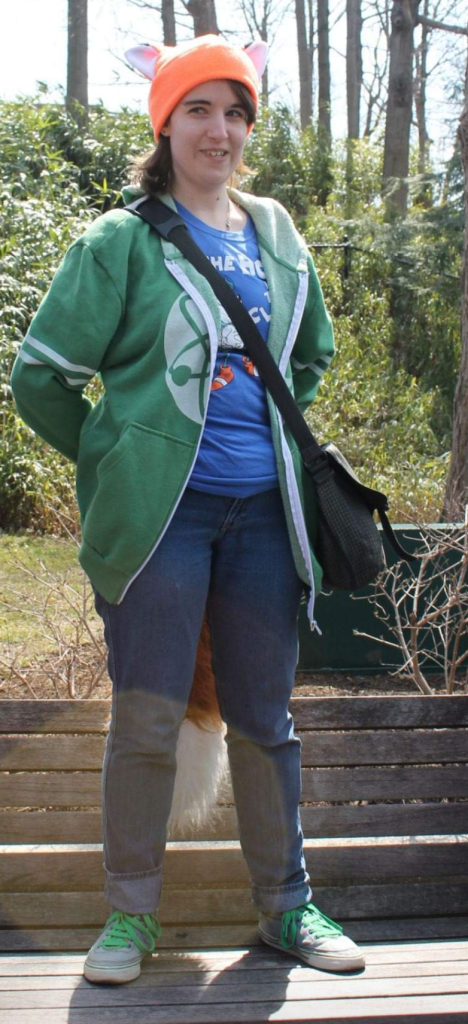
Cool people dress like a fox when visiting the zoo.

When I met my husband in 2012, I was wearing the shoes. That’s not to say that they contributed to him wanting to continue to see me, and eventually marry me, but it couldn’t have hurt.

When Habi the chinchilla died in 2013, I buried him in the Mythical Shoes box.

I don’t wear the shoes anymore, mostly for fear of them getting beat up beyond recognition. But I still have them, as a small memento of Habi, and of the most pivotal time of my life.