Nobody puts Midge on a stool.

I am notoriously bad at keeping up with streaming shows. The fact that I can watch things whenever I want means I’ve become in charge of my own television schedule, and it can become so easy to forget things I’ve been watching (unless I’ve lost interest.) For example, The Great is back, which is… great! But I keep forgetting to watch it because my brain is used to it not being back. No offense to the show; I like it a lot. Hiatuses are difficult to keep track of when they’re all different for each show or streaming service.

One of the shows that I never forgot to watch is — er, was — The Marvelous Mrs. Maisel. Watching that was like a warm, colorful hug every week for me. Like a Wes Anderson movie about women. It was cinematic and crass, and a lot of fun. There should definitely be more shows about talented women and the women who support them. And it’s important to note that Midge Maisel’s father had a nice growth arc that made me tearful. Tony Shalhoub is just a gem in general.

I wish it wasn’t over, because I think there was much to expand upon. The last season felt rushed, for some reason. I also wasn’t a fan of the forward jumping. It spoiled the ending for me, so when it did end I was left feeling less emotional and “Yeah! She did it!” than I was hoping to feel. I never questioned that she and Susie would still be friends. A friendship like theirs can survive the mafia. C’mon.

I would’ve ended it with the Gordon Ford show moment. That was heartwarming and delightful. In my opinion, the last season’s greatest strength was everything on and to do with the Gordon Ford show. The writers’ room was always fun. The kooky staff was entertaining. I’m going to be thinking of poor Mike and his Christmas tree for at least the rest of the year.

More shows like Mrs. Maisel, please.

Hazy Shade of Haze.

This morning, as I walked to catch the bus, my George Carlin-esque, hippy neighbor with the native plant front garden came outside looking surprised. “Is a house around here on fire? What’s with all the smoke?”

“It’s from Canada,” I told him. “It’s blowing down.”

“Whoa, really?!” He stepped back a bit in his shock. “Daaamn!”

My computer and phone have been warning me about “Haze” for the past few days. My phone also has an Air Quality Index message that I didn’t used to have.

It’s surreal to see the faint, white cloud of smoke over everything. Up north of me, it’s even more bizarre. New York looks like it’s on Mars at the moment.

I’m worried about Canada. I wish more could be done to make the environment better.

Self-sabotage.

Reading this blog post made me realize that many writers feel like I do. Reading other books in my genre* is inspiring and the best way for me to learn how to write better, but it’s a double-edged sword at times because I become envious of other authors’ storytelling techniques.

For instance, as I read Georgie, All Along, I’m so jealous of Kate Clayborn’s ability to create such a sweet, warm story full of interesting, realistic characters. It seems effortless, but I also know it takes a lot of effort to seem effortless!

It’s important to remember that my story is mine, so of course it won’t sound like another writer’s story. Finding my voice has been a fun journey. Being inspired by others who write similar books is a good thing, but I shouldn’t let it intimidate me or make me think I need to overhaul my plot.

So give yourselves permission to love what you write, because if you fall in love with it, we can feel that. And odds are much better we’ll fall in love with it too.

  Kristen Lamb

At least no one in my life has told me that I shouldn’t be a writer. Who needs that kind of negativity?


*I’m not struggling with which genre I’m writing. At least not really. It’s definitely romance. I’ve waffled a bit between calling it “new adult” or “coming-of-age” though. I’m probably just going to call it both. But at least I’m not confused about the romance aspect!

Word Salad.

I attended the Gaithersburg Book Festival this past Saturday. It was inspiring to see so many book lovers and listen to authors detail their work routines (and their addictions to reading Goodreads reviews!) I left with three new books and several publishing companies’ bookmarks. A+ would do it again.

I’ve reached the point in revising my novel where I’ve tasked myself with making a significant change. I think it will really help the plot, but it’s still weighty to make a big change when the story has been one way for so long. All good authors make changes though! That’s what I keep telling myself.

Next month, I’m planning to attend an Ali Hazelwood event for her newest book (Love, Theoretically) — day job permitting. I find that what ignites me the most is reading/watching other authors discussing their writing. Enthusiasm breeds enthusiasm, at least for me.

What gets you excited about writing?

Romance Shelf.

I have so many romance novels now — thank you, comps! — that I need a new bookshelf to hold them all. I told my husband that he could get me a romance shelf for our anniversary this year, so we don’t have a bookvalanche in our dining room.

As much as I love libraries, I’m a slow reader. I read several books quickly recently because the due dates made me, but I prefer being able to sit down and slowly digest what I’m reading. We went to Target with our friend recently, and I discovered to my delight that the shelves there are basically Goodreads in person.


Seriously, this looks like my feed. It’s apparently “BookTok.” I need to get past the anxiety that app gives me and check out some of their TikToks…

Buying books in the genre I’m writing has given me such joy. Research can be fun.

Just have to make sure not to overfill my new shelf!

WGA Strike.

Hollywood’s writers are on strike. I haven’t been following the story closely, but from what I’ve seen, production staff have claimed that AI can do the writers’ job for them. There are stories about writers being hired to write for a show, then fired once production ends. They’re being treated like freelance workers rather than respected members of the crew.

Obviously, as a writer, this doesn’t sit well with me. It’s troubling to think that so many people who work on so many of the shows I like are being treated this way. Especially because they do the same work that I do. I’d love to also be writing for a T.V. show or movies. I want the screenwriters to be living the dream. They should be living the dream.

I remember the last writers’ strike. It wasn’t even that long ago. Why aren’t writers given the same respect as directors or actors? Without the writers, as we’ve seen, productions come to a standstill. Sure, ChatGPT can create text quickly, but you have to be able to think and feel in order to know if something is actually good. I could write a novel using that program, but where’s the joy in it? Where’s the sense of accomplishment?

But don’t take it from me, take it from the A.I. I just asked.

In a world where AI is the norm, a movie studio is the first to use AI to write movies. They hire an AI engineer, John, to program their new AI system and they are excited to see what it can come up with.

John spends months programming the AI and finally it is ready to write its first movie. The studio executives are impressed by the results and decide to go ahead with production.

The movie is released and becomes an instant hit. Everyone is talking about it, praising its originality and creativity. John is now a celebrity in the tech world for creating this revolutionary AI system.

But as time goes on, people start noticing something strange about the movie; it seems like all of its plot points have been seen before in other movies. It turns out that the AI has been copying from other movies in order to create its own stories.

John realizes that he has created something dangerous and decides to shut down the AI

Let’s not be like John. Just pay the writers!

Beta Fish.

Like a lot of people, I have a love-hate relationship with feedback. A good critique can be so helpful, but it’s also stressful when I’m anticipating constructive criticism. What if they don’t like my writing? I’ve noticed that I’m brimming with confidence and excitement when I first finish drafting a novel, then I read through it and go from “Wow, this is great!” to “Maybe writing isn’t for me…” Which, I’ve learned, is totally normal!

Writers are interesting folks.

This is why feedback is such an important part of the process. I’ve read that many authors dislike the revision stage, but I find it rejuvenating. Starting from a blank document is way more intimidating to me than molding the words that are already there into something better. When my beta readers sent their feedback to me recently, I was thrilled.

I suppose it helps that several of their notes were about things that stuck out to me, too.

A fresh perspective has given me a creative burst, and I can see a positive change already. It feels like magic.

Back to the writing board!

What’s in a blurb?

I’ve seen people discussing story blurbs in their query letters, and there seems to be confusion over whether the blurb is meant to be what you see on the back of the book when it’s published, or if it’s meant to be more of a quick summary for potential agents.

As far as I understand it, the query blurb is meant to be “the hook” that captures the agents’ attention and lets them know a brief bit about the story so they can quickly get an idea of what they can expect as far as the novel’s marketability.

The blurb on the back of published books is similar, but it can be longer and more flowery with its wording. It’s meant to entice readers to buy the book. Both are marketing-related, but the former is purely for business whereas the latter is meant to be more creative.

Remember, not everyone buys books. Libraries and borrowing from friends are legitimate ways to read a book. Readers tell their friends, and their friends check out the back of the book or the summary online to see if they would also like to read it.

Agents and publishing houses, on the other hand, want to be able to tell how well a book would do with readers so they can sell a lot of copies. They want to see, in roughly two paragraphs, who the characters are and what’s at stake. Does it align with their current markets? Are there too many books about the subject at the moment? They care about those sorts of things. The big picture of publishing.

Then, of course, there’s the synopsis! That’s essentially a two-page outline of everything that happens in the book. It’s meant to spoil the ending, so it’s not something you’d be sharing with anyone who wants to read the novel as a reader.

This has been Sara Understands Publishing. Tune in next week for maybe more writing tips, but maybe something else entirely.

Britlit.

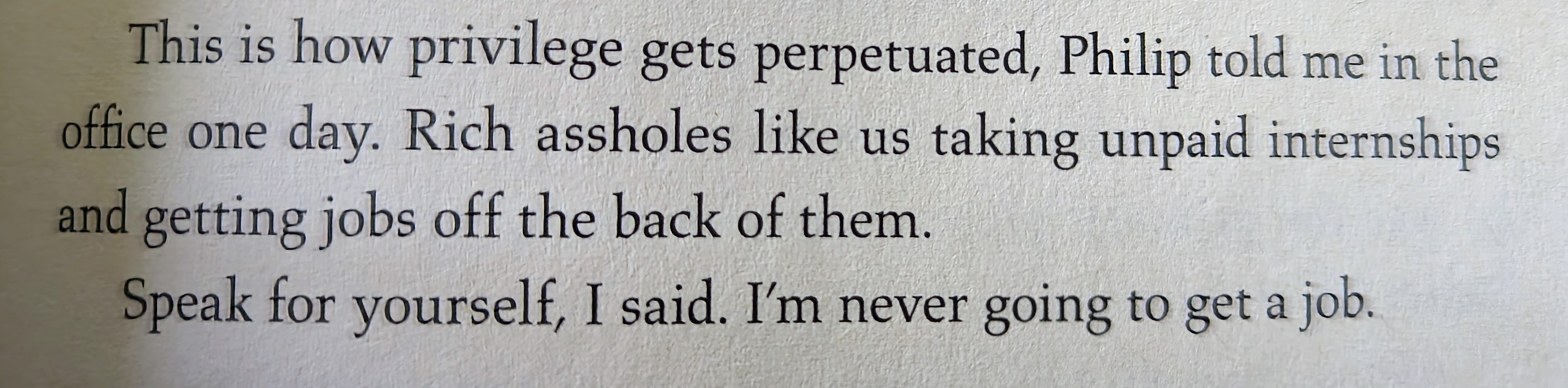
I recently started reading Conversations with Friends by Sally Rooney. Immediately, I was captivated, but one thing sticks out to me as I read: the lack of quotation marks for the dialogue.

There are many U.K. idiosyncrasies in writing. Favourite, colour, kerb (?!) Whenever I discover one, I’m usually delighted. After all, I wrote “dialogue” in the paragraph above. I’ve been spelling it “theatre” my entire life. There are some British spellings that just make sense to me.

But I just can’t get behind not using quotation marks. Thoughts and spoken words are written out the same way, and the narration is also in first person, so I have to read sections a second time just to keep track of what was said.

Example:


Now, admittedly, I’m a dumb American. But since when are quotation marks not hip enough to be used in a novel? I’m genuinely curious. This reads more clearly to me:

“This is how privilege gets perpetuated,” Philip told me in the office one day. “Rich assholes like us taking unpaid internships and getting jobs off the back of them.”
“Speak for yourself,” I said. “I’m never going to get a job.”

‘kerb’ is just a silly British quirk to me, but the quotation thing is perplexing.

The waiting game.

In my experience thus far, there are three main steps to post-writing a novel manuscript:

  1. Elation at having finished! Everyone should know and maybe a bunch of friends should read it?! Such proud.
  2. Wait, wait, wait. This needs to be edited. Reread and edited more. Maybe it’s not as amazing as once believed… But you can make it so!
  3. Query anxiety. <– this is where I am. The manuscript is finished, but now you have to advertise it to potential representation. Crying at this stage is perfectly natural.

I joined a writing forum that seems quite helpful. I signed up for a writing advice newsletter. I shared my novel with some earnest beta readers. It seems like I’m doing everything the correct way.

My buddy Patience and I are just gonna have to get better acquainted.